Does an Avatar Improve Perceived Empathy in AI Chatbots?
A controlled A/B test of how an avatar actually affects users' perceived empathy, giving conversational-AI teams evidence for the investment decision.
- Embodied Agent Research Project
- Period
- May 2025 – Dec 2025
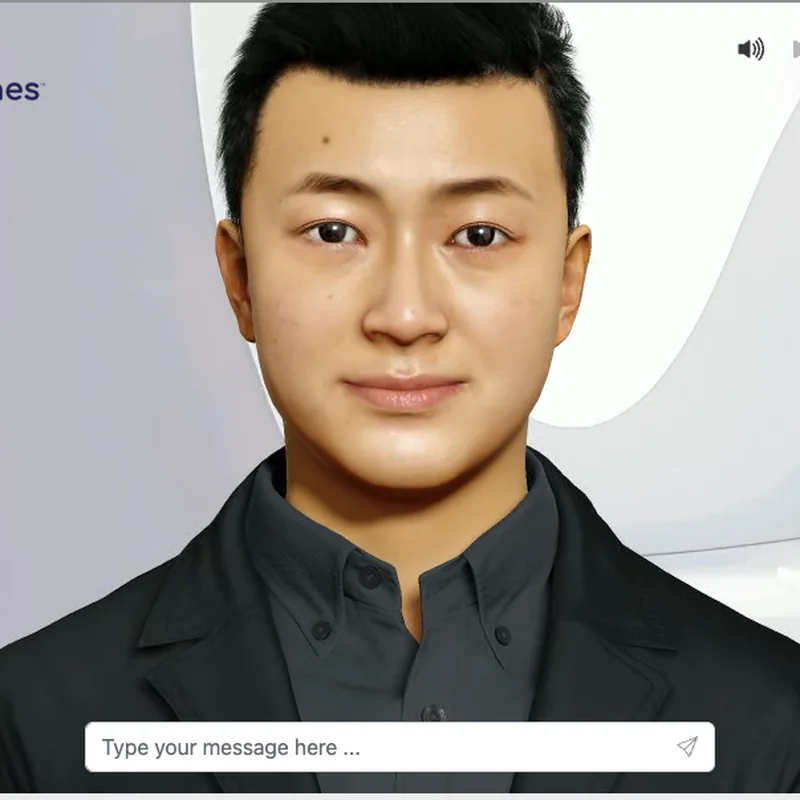
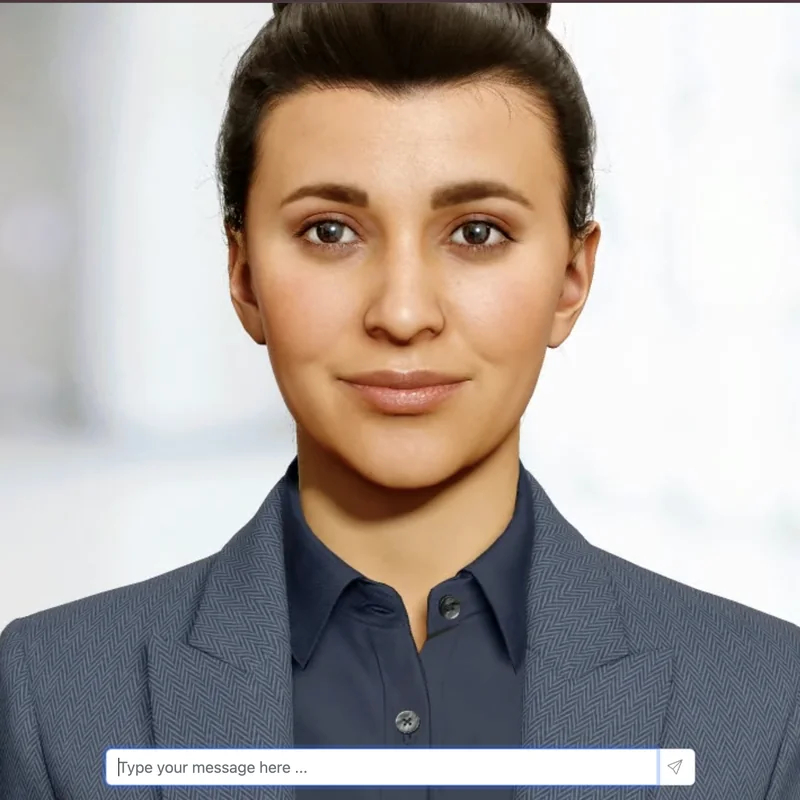
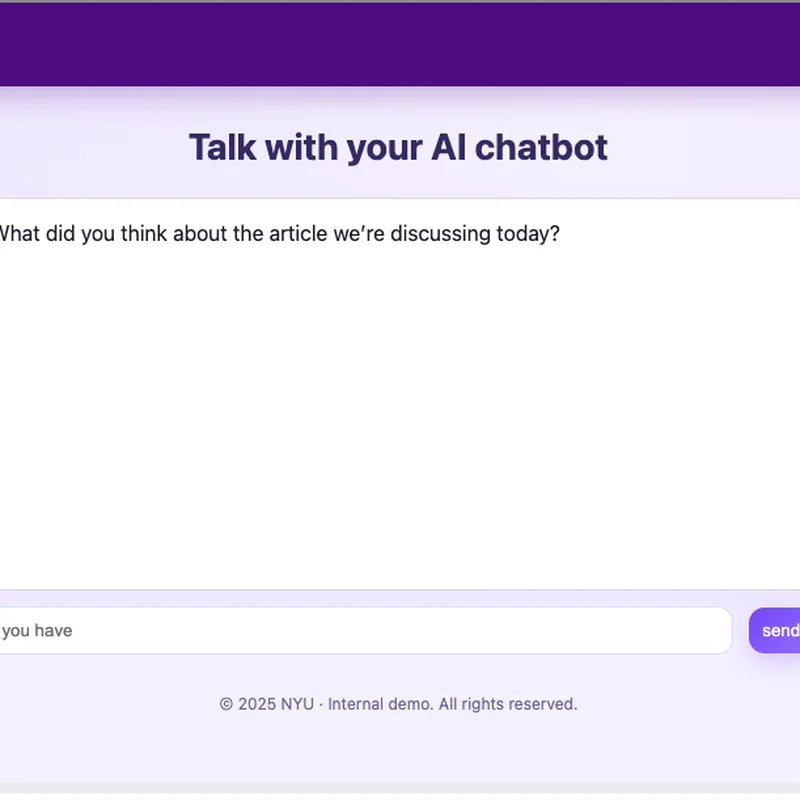
The interfaces as participants saw them: the avatar condition (male- and female-presenting) and the text condition. All three run on the same backend, the same model, and the same persona prompt, so any difference in experience is attributable to interface form alone.
- A/B test avatar vs. text conditions
- 186 real human–AI conversations
- CHI 2026 accepted to BiAlign Workshop
01 The problem
Conversational AI carries an assumption that is rarely questioned: give an AI a talking, expressive 3D avatar and users will judge it as warmer and more understanding. The assumption carries a concrete cost — platform licensing, animation and voice tuning, rendering compute — and in emotionally sensitive domains such as mental health, companionship, and clinical intake, many teams treat that spend as the default.
In the prior literature, however, the variable has almost never been tested in isolation. Earlier comparisons typically differed in model, prompt, and scripted content as well as in interface, so “the avatar felt warmer” could equally have meant “that build had better copy.”
We reduced it to a product question: does the spend hold up? Answering it requires isolating interface form from the model, the prompt, and the dialogue content, and comparing it on its own.
02 The A/B test
The experiment ran two conditions, avatar and text, with participants randomly assigned. The avatar arm was further split into male- and female-presenting characters, to rule out a result driven by appearance preferences for a single character.
Held identical across conditions:
| Model | GPT-4.1-nano, temperature 0.7 |
| Persona prompt | One identical system prompt, verbatim |
| Stimulus | One shared pool of 25 empathy-evoking negative news articles |
| Session logic | Identical context construction, turn counting, completion-code rules |
| Data | Identical MongoDB document schema |
The experimental constraints were written directly into the prompt. The persona prompt carries three hard rules — no more than two sentences per reply, no admission of being an AI, and no completion code before turn 10 — corresponding to three purposes: holding information density constant across conditions, preventing participants from re-anchoring their judgments once they know what they are talking to, and guaranteeing every conversation is long enough to analyze.
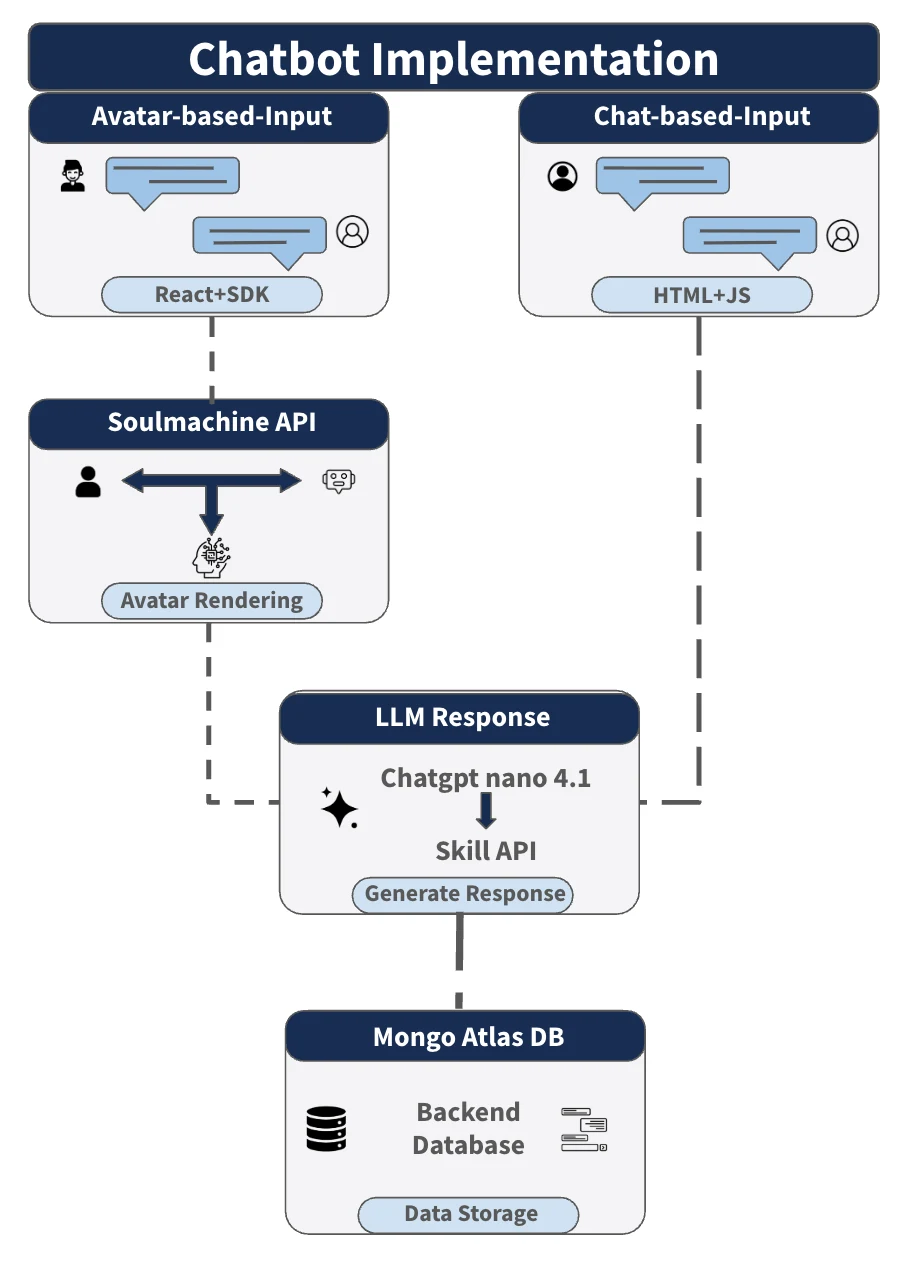
Technical: The avatar side is registered as a Skill on the Soul Machines platform, which calls back into the backend during an interaction; the text side is a FastAPI service talking to OpenAI directly. Conversation-processing logic is identical across both.
03 Two products, different form, same backend
The avatar frontend is built on React and the Soul Machines Digital Person SDK. On initialization it opens a WebSocket to the platform for bidirectional audio and video streaming; input is by voice (platform STT) with typing as a fallback, and the character renders in real time with facial animation synchronized to speech.
The text frontend is a minimal single page containing only a history area, an input field, and a send button, with no component hierarchy or state-management framework.
Both ends run the same backend logic: URL parameters identify the participant and the article they read, the article text and the persona prompt together form the conversation context, history is maintained turn by turn against the same model, and everything is written to MongoDB under one schema. The difference lives entirely in the frontend; the backend path is identical.
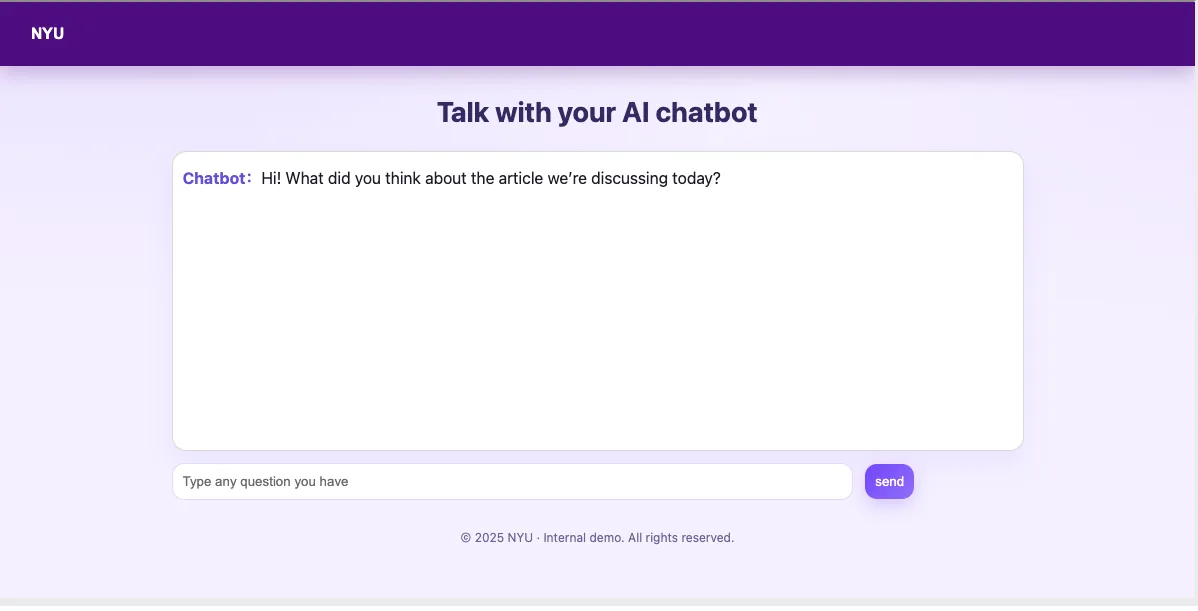
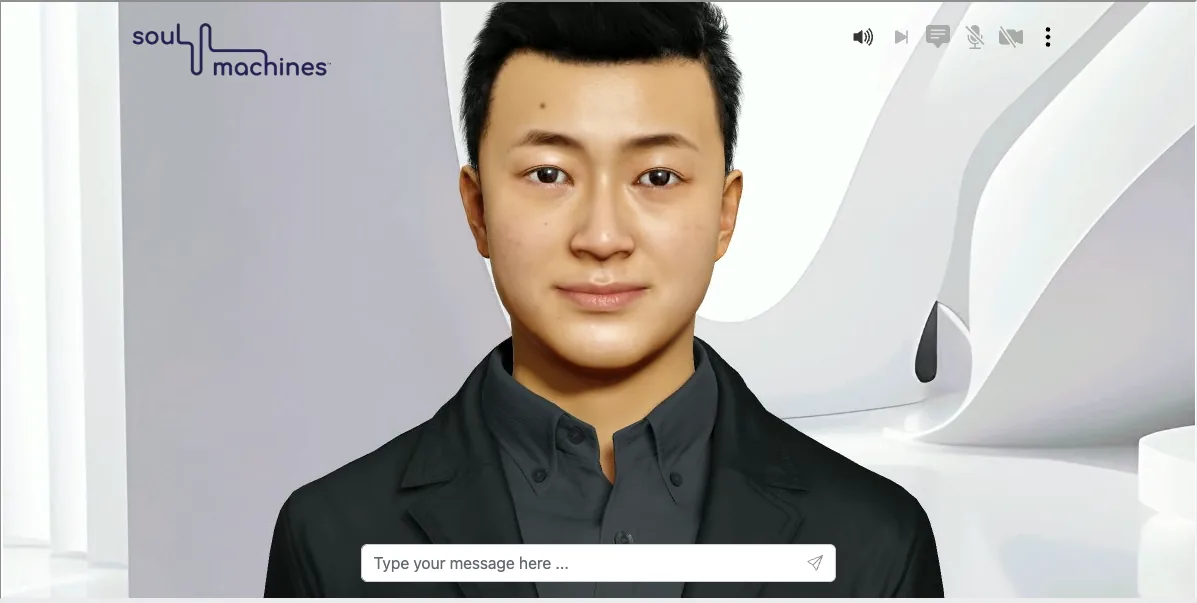
Both products were served behind Nginx and embedded as iframes inside the Qualtrics instrument, so participants completed the conversation without leaving the survey. Participants were recruited on Prolific (US, native English, 18+, desktop with camera and microphone) for $2.
04 Making empathy measurable
Empathy is a subjective impression with no ready-made scale. Rather than construct one, every item was mapped onto a validated psychological instrument to preserve construct validity. Three were used:
- SPUR social presence scale — the body of the post-conversation survey, across three dimensions: Perceived Conversation Quality (PCQ), 14 items covering fluency, grammar and semantics, topical relevance and progression, emotional understanding, warmth, and personalization; Perceived Empathy (EMP), whether the partner was felt to show genuine empathy; and Trust, covering trustworthiness, approachability, and authenticity.
- Godspeed questionnaire — semantic differentials measuring anthropomorphism, animacy, likeability, perceived intelligence, and perceived safety. The anthropomorphism subscale later proved central to explaining the mechanism.
- BFI-20 personality inventory — the 20-item short Big Five drawn from the IPIP pool, administered before the conversation to control for individual differences in regression, principally extraversion and agreeableness.
The participant path:
| Stage | Content |
|---|---|
| Screening & consent | Prolific targeting → informed consent → Prolific ID captured automatically |
| Pre-test | BFI-20 personality inventory (20 items) |
| Stimulus | Read one empathy-evoking negative news article (pool drawn from the WASSA dataset, with empathy/distress annotations) |
| Interaction | Randomly routed into the embedded text or avatar window, at least 10 turns, then retrieve a completion code |
| Post-test | PCQ → EMP → Trust → Godspeed, all on 7-point scales |
The instrument follows one principle: items are worded in everyday language participants can answer directly, while mapping onto established scales. “Do you think your conversational partner had genuine empathy?” invites a natural answer, and in the data it is one item of the EMP composite.
05 Results
186 valid conversations after removing incomplete responses and sessions under six turns: 93 text, 49 male avatar, 44 female avatar.
The text condition scored higher on all three measures:
| Measure | Text | Avatar | Test |
|---|---|---|---|
| Perceived empathy (EMP) | 5.25 (SD 1.24) | 4.86 (SD 1.31) | t = −2.09, p = .038 |
| Conversation quality (PCQ) | 5.85 (SD 0.83) | 5.55 (SD 0.87) | t = −2.35, p = .020 |
| Trust | 5.34 (SD 1.16) | 4.97 (SD 1.26) | t = −2.07, p = .039 |
The difference does not stem from sample composition: with demographics (sex, ethnicity), personality (extraversion, agreeableness), and total conversation tokens entered into an OLS model, interface modality remains a significant negative predictor (β = −0.438, p = .018). The result therefore cannot be attributed to shorter avatar conversations or to a harsher group of raters.
The two avatar presentations landed close together (male 4.91, female 4.80), ruling out bias from a single character.
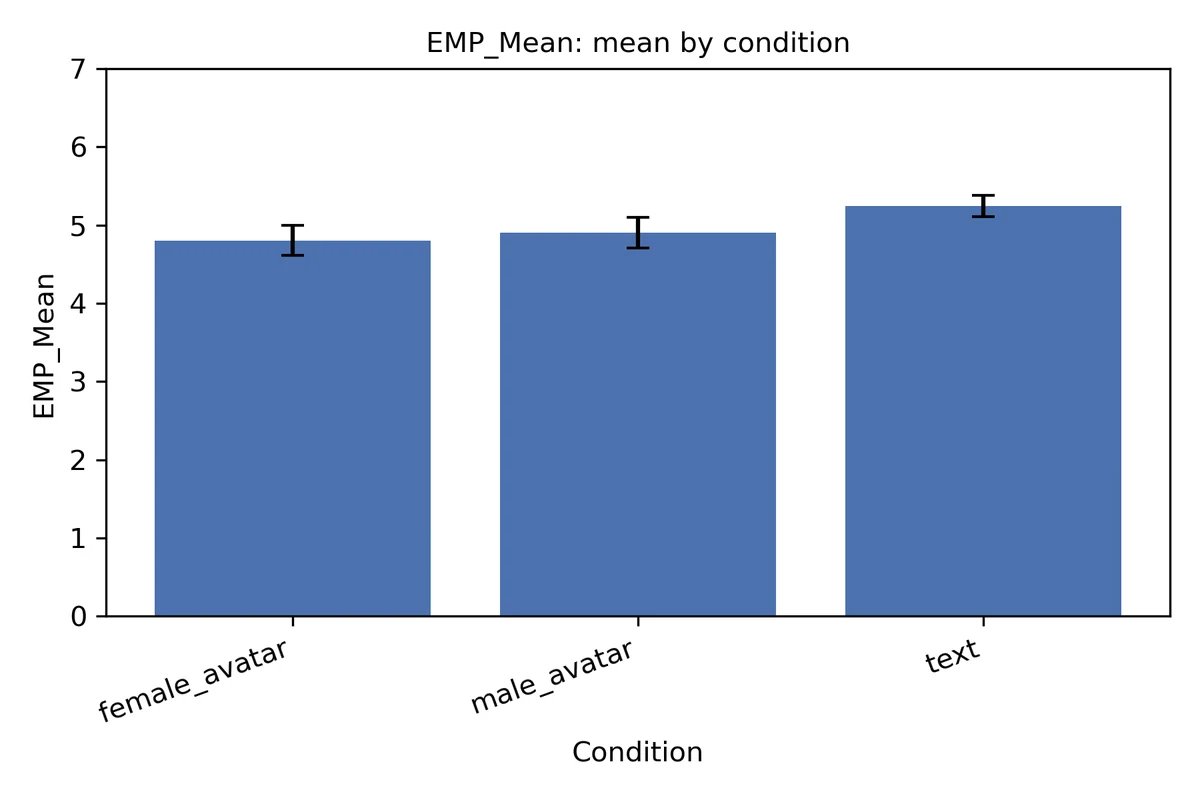
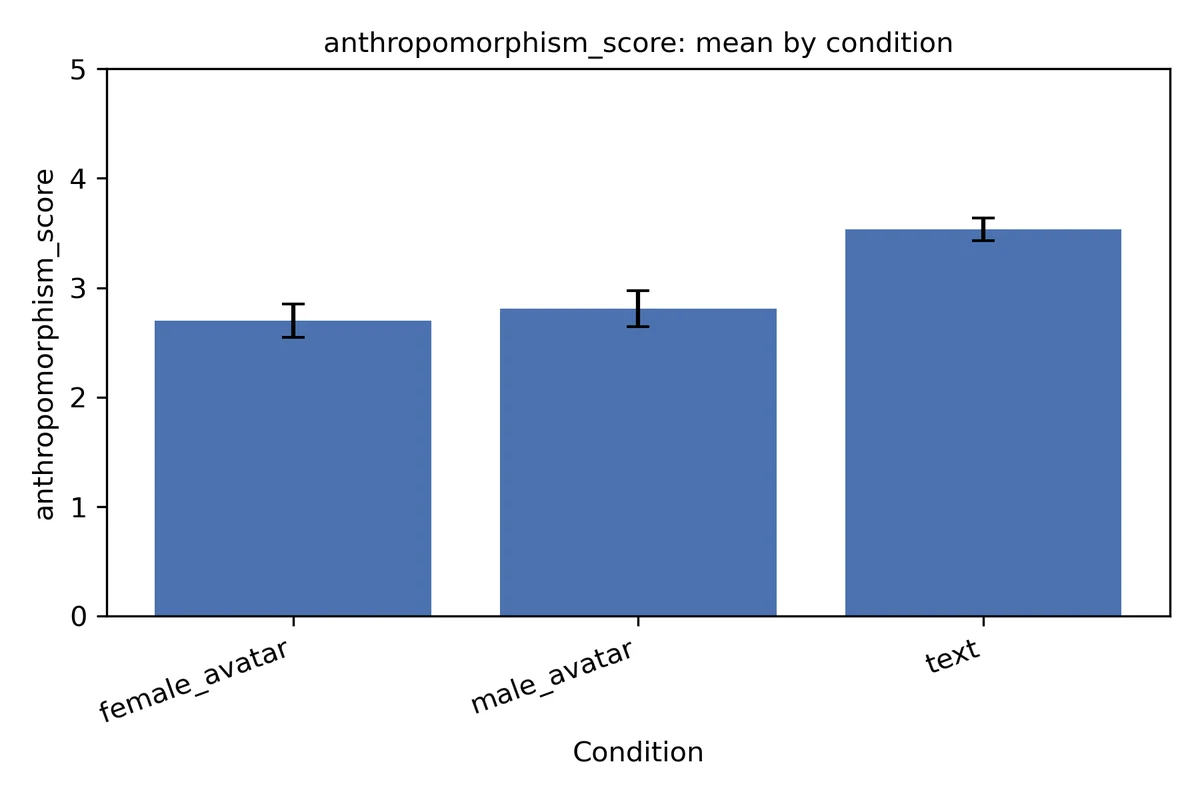
The mechanism sits in the Godspeed anthropomorphism subscale: participants found the text chatbot more humanlike (3.52 vs 2.76, t = −5.01, p < .001). With anthropomorphism entered into a mediation model, the direct coefficient for modality flips sign (β = −0.438 → +0.29, p = .029), indicating that the avatar’s negative effect on empathy runs entirely through anthropomorphism.
Expectancy Violations Theory accounts for this: a moving human face simultaneously raises expectations of expression, prosody, and interactional timing, which current avatar technology cannot meet. Once that gap appears, users apply a stricter standard to identical dialogue content. A text interface raises no such expectations and therefore incurs no such gap.
06 Language, or the face?
One alternative explanation had to be ruled out: the avatar condition’s dialogue might simply have been lower in quality. If so, the finding would reflect conversation quality rather than embodiment.
To test this, we set the interface aside and estimated empathy from the dialogue text alone, comparing the two conditions at the linguistic level by two independent methods.
① Fine-tuned Transformers, empathy modeled as regression. On the WASSA 2024 shared-task dataset we fine-tuned and benchmarked five architectures — DeBERTa-v3, RoBERTa, BERT, DistilBERT, TinyBERT — taking multi-turn dialogue with speaker tokens as input and predicting a continuous empathy score. DeBERTa performed best (test-set Pearson r = 0.4153, p < .05). A frozen-backbone baseline ran alongside to confirm the gains came from fine-tuning rather than model priors; the trained models were then applied to this study’s conversations to produce a purely text-based empathy estimate.
② LLM-as-a-judge. GPT-4o and GPT-4.1 scored empathy directly from text. Before scoring, all identity fields were removed and speakers relabeled “Person 1” and “Person 2,” leaving the judge unable to tell which party was human, which was a bot, or which condition the exchange came from. It was then asked to predict, on the same items participants answered, how Person 1 would rate Person 2’s empathy on a 1–7 scale, averaged across items.
Both methods reached the same conclusion: text-level empathy differed only slightly between the avatar and text conditions, and not in a stable direction, while the participant-reported difference was significant. What the two groups actually said was comparably empathetic; what changed the judgment was interface form. The explanation that avatar conversations were simply lower in quality is ruled out, and the causal link between form and perceived empathy holds.
Technical: Fine-tuning used hierarchical learning rates (encoder 1e-5 with 0.95 layer-wise decay, head 5e-5), progressive unfreezing, gradient clipping, and early stopping, with inputs truncated to 512 tokens.
07 Conclusion
Visual embodiment does not automatically improve emotional experience; it changes the standard by which users judge — an avatar raises expectations that current technology cannot yet meet. For product decisions: in empathy-driven use cases an avatar should be validated before it is purchased, and if one ships, the outcome is decided not by visual fidelity but by lip-sync, prosody, interruption handling, and latency — the parts that determine whether the raised expectations are met.
The paper, When Embodiment Backfires: The Impact of AI Chatbot Avatars on Human Perceived Empathy, was accepted to the CHI 2026 BiAlign Workshop, and releases the dataset of 186 dialogue logs paired with survey responses.